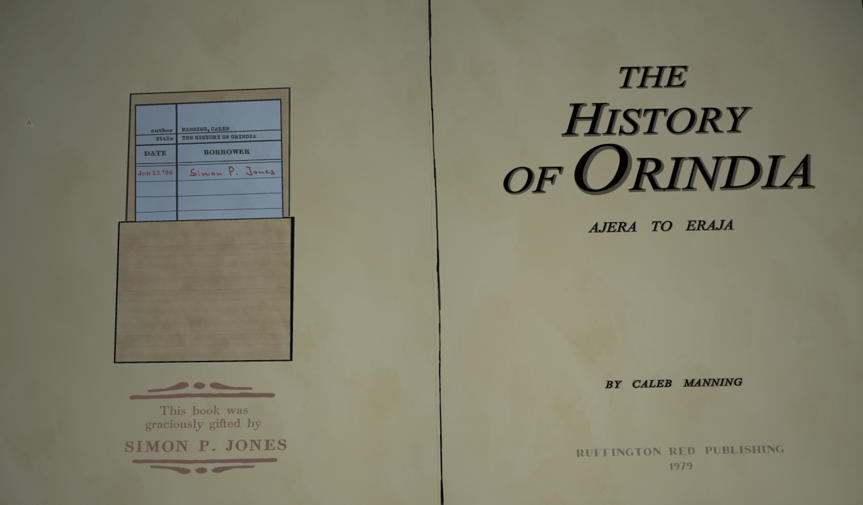
THE HISTORY OF ORINDIA (1st ed.)
Durante nossa jornada em Blue Prince, encontraremos uma grande quantidade de livros. Muitos deles contêm pistas importantes — em alguns casos, para compreendê-las, é preciso entender inglês e seus trocadilhos. Ainda assim, isso não nos impede de apreciar as histórias por trás desses livros. Por isso, resolvi traduzir todos eles, para que todos possam aproveitar dessa experiência.
Atenção: não continue a leitura se não quiser spoilers!
“Se este conteúdo foi útil para você, nos ajude se inscrevendo no nosso YouTube e/ou Instagram: @Euprofessor e @Eu.professor.”
TEXTO TRADUZIDO
THE HISTORY OF ORINDIA
AJERA TO ERAJA
By
CALEB MANNIG
PRÓLOGO
ORÍNDIA foi, em tempos passados, o nome usado para designar os reinos das águas orientais. Embora o termo já não seja empregado nas esferas da política, nem conhecido comumente pelo cidadão médio, sua memória ainda brilha nos corações daqueles que vêm das terras outrora por ele abarcadas, e muitos da geração mais velha, em círculos reservados, ainda se referem a si mesmos como Orindianos.
No entanto, não devemos permitir que a chama de nossa história se apague até se tornar apenas um sussurro, nem deixar que nossos líderes nos façam abandonar o nome de nossa terra. Devemos manter vivas as brasas do nosso passado e preservá-las para as gerações que ainda virão.
I — AJERA
A maioria dos historiadores marca o início da primeira era, frequentemente chamada de Ajera, pela ascensão do primeiro rei de Oríndia, cujo nome, Oris, viria mais tarde a nomear a crescente vila onde foi coroado. Oris era conhecido, antes de sua coroação, como um proeminente senhor mercador de considerável riqueza e influência, cujo poder na região o tornava o candidato ideal para unificar as províncias vizinhas.
Infelizmente, a história nem sempre é generosa, e os registros sobreviventes daqueles tempos remotos limitam-se, em sua maioria, a acordos comerciais e recibos de venda.
Ainda assim, podemos deduzir desses registros que Oris tinha um único objetivo: a expansão. O território se espalhou a partir do coração de Oris e, ao final do primeiro século, as bandeiras negras de Oríndia tremulavam em cada aldeia e hospedaria, ao longo de todas as estradas, desde Oris até as margens do oeste. Um novo reino havia nascido.
II — SEGUNDA ERA
Foi o quarto rei de Oríndia quem dividiu esse vasto domínio em partes iguais. Três reinos para seus três filhos.
Ao mais velho, concedeu os campos e montanhas de seu bisavô, a província central e coração do reino. O primogênito aceitou o presente e chamou seu novo reino de Orinda Aries, em homenagem ao modelo angelical da realeza, Orinda.
Ao mais novo, entregou o reino de Arch Aries, a terra das Tempestades do Norte. Uma extensão selvagem e indomada que, na época, era menos desenvolvida, mas consideravelmente mais vasta do que o lote do irmão mais velho.
E à sua filha do meio, sua única filha, ele presenteou com a região sul de Eraja, o reino místico dos ancestrais, uma terra impregnada de tradição, magia e da poesia da língua antiga.
III — TERCEIRA ERA
Ao final da Segunda Era, os três reinos soberanos haviam alcançado um período de progresso e prosperidade notáveis. Cada uma dessas regiões distintas, governadas por seus respectivos monarcas irmãos, florescera, cultivando os recursos abundantes de suas terras e desenvolvendo um caráter e cultura únicos que as diferenciavam umas das outras.
Apesar dessas diferenças, os monarcas irmãos conseguiram manter relações amistosas durante toda a vida, e eram conhecidos por sua cooperação em assuntos de comércio e transporte. As gerações seguintes de seus herdeiros continuaram essa tradição, e a Terceira Era foi marcada pela construção de uma vasta rede de ferrovias que atravessava toda a extensão da terra, ligando as montanhas do norte de Arch Aries às praias do sul de Eraja. Esse desenvolvimento facilitou as viagens e o comércio entre os três reinos, fortalecendo ainda mais seus laços e lançando as bases para a promessa de um futuro próspero e brilhante — uma promessa que, como meus leitores logo verão, não seria cumprida.
IV — QUARTA ERA
Ao adentrar a Quarta Era, o reino de Orinda Aries viu ascender ao trono um tipo diferente de governante. O rei Desilets III era um rei que escutava as vozes de todos os seus súditos, dos conselheiros mais influentes ao mais humilde cidadão.
Era um rei frequentemente visto entre o povo, comendo, bebendo e conversando — uma cena que chocava não apenas a nobreza e a corte, mas também as massas, que mal podiam acreditar que eles, como camponeses, um dia ceariam com a coroa.
Desilets ficou conhecido como “O Rei do Povo”, e não surpreendeu a ninguém quando decidiu transferir a capital das montanhas isoladas de Reddington para o palco público de Oris, deixando castelo e corte para trás. O povo ficou extasiado com essa decisão, e a cidade recebeu seu rei com braços abertos e grande festa. No entanto, nem todos foram tão facilmente convencidos. Havia aqueles que viam a conduta do rei como indigna de seu posto, e temiam o quanto ele era facilmente persuadido pelas lágrimas e histórias do povo comum.
Essas vozes dissidentes plantaram as sementes da insatisfação, que criaram raízes nos jardins e gramados dos nobres de Fenn, ou, como fui instruído a dizer, a Grande Cidade de Fenn.
V — ERA DA RUÍNA
Após a morte do Rei Desilets III, a Quarta Era chegou a um fim abrupto. Felizmente, o rei faleceu de causas naturais, já idoso e cercado por seu povo em Oris, longe da crescente tensão na cidade ocidental de Fenn.
No dia seguinte, 6 de outubro, o autoproclamado Príncipe Leerson de Fenn declarou-se o verdadeiro monarca. Essa proclamação foi apoiada por um número surpreendente de partidários, devido ao fato de que Desilets IV, embora herdasse o bom nome de seu pai, carecia de suas virtudes.
Com a perspectiva de uma guerra civil parecendo inevitável, os regimentos do reino foram apressadamente chamados de volta das fronteiras para sufocar e pôr fim à chamada “Fennsurreição”. No entanto, em vez de restaurar a ordem, o que se seguiu foi uma campanha brutal e implacável contra seu próprio povo. Os jardins de Fenn, outrora símbolo de esplendor, transformaram-se em campos de batalha enquanto os gritos dos inocentes ecoavam pelas ruas da cidade, manchadas de sangue.
A brutalidade da pacificação de Fenn não passou despercebida pelos vizinhos. À medida que a simpatia pela cidade crescia, aliados surgiram para oferecer apoio. Entre eles estava o general do Regimento do Norte, que, enojado pelas ações bárbaras dos outros batalhões, uniu forças com o Príncipe Leerson para formar um exército formidável. Juntos, usaram sua influência política e dívidas de favor para convencer os reinos próximos de Arch Aries e Nuance a se juntarem à causa.
Contudo, mesmo com a maré virando a seu favor, a vitória não veio facilmente. A Guerra da Quinta Era durou longos 22 anos, e custou a vida de um em cada três homens. O próprio Príncipe Leerson foi uma das baixas. No entanto, mesmo na morte, ele venceu. Oris caiu, e com ela, o reino. As bandeiras negras que haviam tremulado por cinco eras foram queimadas, e em seu lugar, bandeiras vermelhas foram hasteadas em honra aos caídos de Fenn. Os cinco membros sobreviventes da antiga família real fugiram para o sul com medo de perderem a vida, exilados para sempre.
VI — A ERA ATUAL
Hoje, os reinos herdados pelos Três — Fenn Aries, Arch Aries e Eraja — mais uma vez permanecem unidos como aliados. Embora a distância entre nossos povos tenha aumentado, nossa ligação com esta terra continua tão forte quanto sempre foi. Os abetos e as bétulas que se estendem por nossos domínios servem como lembrete constante de que todos partilhamos um passado comum. E à medida que essas árvores continuam a crescer, também crescem nossas esperanças por um futuro comum. Um futuro no qual não sejamos definidos pelas cores das bandeiras que erguemos, mas sim por aquilo que nos conecta. Uma terra que todos chamamos de lar.
Pois esta é, apesar de tudo o que aconteceu, uma terra rica em história, uma terra de mitos e maravilhas, uma terra que deu origem ao maior império que o mundo já viu, a terra de nossos pais, de nossas mães e de nossos filhos.
Esta terra é, depois de tudo…
… ainda Oríndia.
TEXTO ORIGINAL
FOREWARD
ORINDIA was once the name used to designate the realms of the eastern waters. Though the term is no longer employed in the halls of politics, not commonly known to the average citizen, its memory flickers in the hearts of those who hail from the lands that it once encompassed, and many of the elder generation, in hushed circles, still refer to themselves as Orindians.
Yet, we must not let the flame of our history dwindle into the obscurity of whispered conversations, nor permit our leaders to enjoin us to abandon the name of our land. We must keep alive the embers of our past and preserve them for the generations yet to come.
I AJERA
Most historians mark the beginning of the first era, often denoted as Ajera, by the ascension of the first king of Orindia whose name, Oris, would later grace the burgeoning township in which he was crowned. Oris was known, before his coronation, as a prominent merchant lord of considerable means and affluence, whose sway in the region made him the ideal candidate for the unification of the surrounding provinces.
Regrettably, history is not always forthcoming, and the surviving records of those bygone days are mostly limited to trade agreements and sales receipts.
Nevertheless, we can deduce from these ledgers that Oris had but one aim: expansion. The territory spread forth from the heart of Oris and by the end of the first century, the black banners of Orindia could be seen fluttering in every hamlet and hostelry, along every thoroughfare, from Oris, all the way to the western banks. A new kingdom was born.
II SECOND ERA
It was the fourth king of Orindia who split this vast domain in equal shares. Three Realms for his three children.
To the eldest, he granted the fields and mountains of his great grandfather, the middle province and heartspring of the kingdom. The eldest accepted the gift and called his new realm ORINDA ARIES, after the angelic paragon of royalty, Orinda.
To the youngest, he bestowed upon him the realm of ARCH ARIES, the land of the Northern Storms. A wild and untamed expanse which at the time was not as developed but a good deal more vast than the eldest brother’s lot.
And to his middle child, his only daughter, he gifted her the southern region of ERAJA, the mystical realm of the ancestors, a land steeped in tradition, magic and the poetry of the old tongue.
III THIRD ERA
As the Second Era drew to a close, the three sovereign realms had achieved a period of remarkable progress and prosperity. Each of these distinct regions, ruled by their respective sibling monarchs, had blossomed, cultivating the bountiful resources of their lands, and developing a unique character and culture that set them apart from one another.
Despite those differences, the sibling monarchs managed to maintain friendly relations throughout their lives, and were known for their cooperation in matters of trade and transportation. The succeeding generations of their heirs continued that tradition and the Third Era was defined by the construction of a vast network of railways that spanned the length and breadth of the land, linking the northern mountains of Arch Aries to the southern shores of Eraja. This development facilitated travel and commerce between the three realms, further strengthening their bond and laying the foundation for the promise of a prosperous and bright future, a promise that would unfortunately, as my readers will soon find, not be kept.
IV FOURTH ERA
As the kingdom of Orinda Aries entered the fourth era, a different kind of ruler took the reins of power. King Desilets III was a king who listened to the voices of all his subjects, from the most influential advisors to the humblest of citizens.
He was a king who often was seen among the people, eating, drinking and conversing – a sight that shocked not only the gentry and the court, but the masses as well, who could scarce believe that they, as peasantry, would ever sup with the crown.
Desilets was renowned as “The King of the People” and it was therefore a surprise to no one when he made the decision to move the capital from the secluded mountains of Reddington to the public stage of Oris, leaving castle and court behind. The people were overjoyed by this choice, and the city welcomed their king with open arms and great fanfare. Yet, not all were swayed so easily. There were those that viewed the king’s conduct to be unbecoming of his station, and were wary of how readily he could be persuaded by the tears and tales of the common folk.
These dissenting voices planted the seeds of discontent, which took root in the lawns and gardens of the nobles of Fenn, or as I have been instructed to say, the Grand City of Fenn.
V ERA of RUIN
After the passing of King Desilets III, the Fourth Era came to an abrupt end. Thankfully, the king died naturally in his old age and surrounded by his people in Oris, far away from the growing unrest among the western city of Fenn.
On the very next day, the 6th of October, the self-proclaimed Prince Leerson of Fenn declared himself the true monarch. This declaration was bolstered by a surprising number of supporters, due to the fact that Desilets IV shared his father’s good name but little of his virtues.
As the prospect of civil war seemed inevitable, the realm’s regiments were hastily recalled from the frontiers to stamp out and put an end to the “Fennsurrection”. However, instead of restoring order, what ensued was a savage and merciless campaign against their own people. The gardens of Fenn, once a center of splendor, were transformed into a battlefield as the cries of the innocent echoed through the city’s streets, stained in red.
The brutality of the pacification of Fenn did not go unnoticed by neighbors. As sympathy for the city surged, allies came forward to lend support. Among them was the general of the Northern Regiment who, sickened by the barbaric actions of the other battalions, joined forces with Prince Leerson to form a formidable army. Together, they leveraged their political influence and favors to persuade the nearby realms of ARCH ARIES and NUANCE to join their cause.
However, even with the tide turning in their favor, victory did not come easy. The War of the Fifth Era lasted 22 long years, and saw buried one in every three men. Prince Leerson himself added another number to the casualties. However, even in death, he had won. Oris had fallen and with it the realm. The black flags that had flown for five eras were burned, and in their place, red banners were hoisted in honor of the fallen of Fenn. The five remaining members of the former royal family fled in fear of their lives to the south, forever exiled.
VI THE CURRENT ERA
Today, the realms inherited by The Three, FENN ARIES, ARCH ARIES and ERAJA once again stand united as allies. Though the distance between our peoples has grown, our connection to this land remains as strong as ever. The spruce and birch that span across our realms serve as a constant reminder that we all share a common past. And as those trees continue to grow, so do our hopes for a common future. A future where we are not defined by the colors of the banners we raise, but by that which connects us. A land that we each call home.
For this is, despite everything else, a land rich in history, a land of myth and wonder, a land that sprung forth the greatest empire the world has ever seen, the land of our fathers, of our mothers, and of our children.
This land is, after all that has happened…
… still Orindia.
RETORNAR
GAMES CINEMA FRANCÊS SOBRE CONTATOS
“Se este conteúdo foi útil para você, nos ajude se inscrevendo no nosso YouTube e/ou Instagram: @Euprofessor e @Eu.professor.”

 EuProfessor — Jogos, Cinema e Francês
Deixe um comentário